Pipeline Management Sales for Public-Sector Bids
Learn how pipeline management sales works for state and local government: stages, records, weighted forecasts and cooperative contract checks.
The Monday pipeline call goes fine until someone asks why the year looks soft. You open the tracker: 34 open opportunities, a face value that clears target by a comfortable margin, and a weighted total built on stage percentages nobody has reviewed since the CRM was configured. Then the school district bid that has sat at 70% since March gets rebid in the fall, the county's radio replacement turns out never to have been funded, and a state contract you counted on renewing went to the incumbent months ago. The number was never a forecast. It was a list of hopes with decimal places.
Public-sector pipeline management fails for a specific reason. Standard stages measure what your team did. Government buying turns on what the buyer has approved, funded, posted, evaluated, and signed. Those are different events, and only one of them can be verified from a document.
This rebuilds pipeline management sales practice for state, local, and education work around buyer evidence: the seven stages a public opportunity really passes through, the fields that make each record checkable, the weighting method that turns your own closed bids into probabilities, and the purchasing-route checks that decide whether a sale is even possible.
Why Government Sales Pipelines Break Standard Models
A sales pipeline is the set of open opportunities, each placed in a defined stage and weighted by its chance of closing, so leaders can see how revenue is likely to arrive. Coverage compares the value of those open opportunities against the sales target. Both depend on stages meaning the same thing to everyone who touches the record.
Standard B2B guidance expects stage conversion to be read in context. Surveyed B2B teams reported median conversion rates of 11% to 20% at each of the first three transitions, lead to marketing-qualified lead, marketing-qualified lead to sales-qualified lead, and sales-qualified lead to opportunity, according to a Belkins analysis of pipeline conversion data. That attrition assumes a seller who can influence the next step with a call, a demo, or a discount.
Government buyers don't hand you that lever. Say a contractor spots a school district notice in March for classroom furniture, forecasts a summer purchase, and builds the quarter around it. In June the district confirms the item was never in the approved budget. In October, a revised version of the same bid posts. A conventional pipeline would have carried that deal at high probability for seven months, and every review in between would have treated it as healthy.
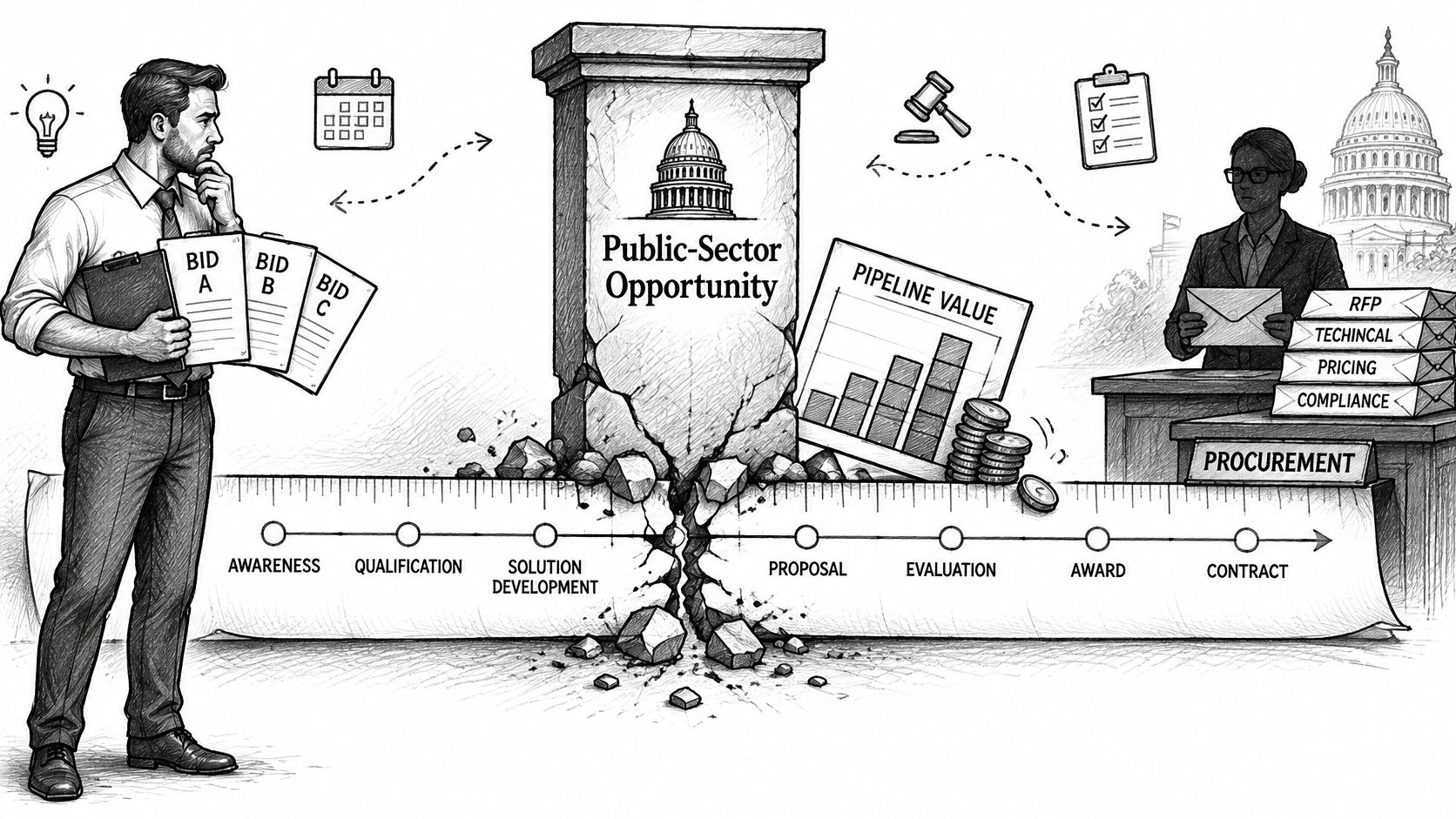
A solicitation is the formal request a government issues when it wants bids or proposals, and its posting is a hard gate, not a signal. Between your first hearing about a need and a signature, the purchase has to clear a budget appropriation, a posted solicitation, a mandatory requirements checklist, an evaluation committee, a protest window, and often a board vote. Each gate kills deals, and each is documented somewhere public. Where those documents live is the whole game: we cover the roughly 90,000 counties, cities, school districts, and special districts that run their own bids, alongside state portals and purchasing co-ops, at State and Local Bid Reviews.
Track the handoffs, not the runner's mood. A relay official records each baton pass before the next leg counts.
The Seven Stages of a Public-Sector Opportunity
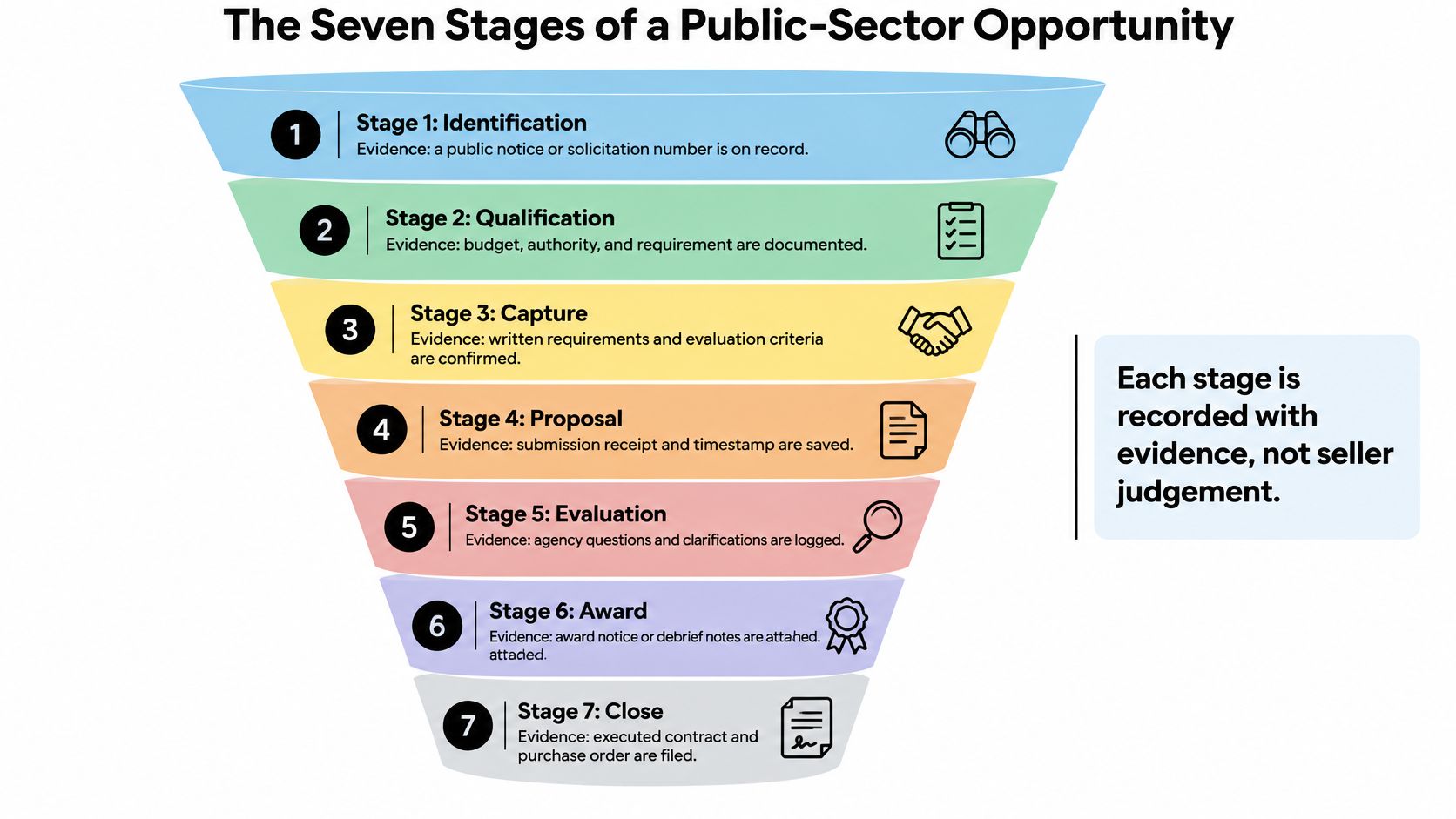
A government opportunity moves through seven stages, and each one should be recorded with evidence rather than a seller's judgement. That's the whole framework. Everything else in this article is bookkeeping around it.
What each stage has to prove
| Stage | Evidence to record | Exit test |
|---|---|---|
| 1. Anticipated need | Budget line, agency plan or board agenda item | Need is documented with a source date |
| 2. Budget evidence | Approved funding source, or a note that the item is unfunded | Funding status is confirmed |
| 3. Pre-solicitation notice | Notice date, posting source and expected solicitation date | Solicitation date is confirmed or the notice is dropped |
| 4. Published solicitation | Solicitation number, bid due date and question deadline | Compliance check is complete |
| 5. Submitted response | Delivery receipt and submission time | Agency has confirmed receipt |
| 6. Apparent award | Notice of intent to award and protest period end date | Protest period has closed |
| 7. Executed contract | Signed agreement, start date and expiration date | Contract is in effect and expiration is recorded |
Stage 2 is the one that gets skipped. An unfunded line item is real intelligence and worthless probability, and the record needs to say so explicitly rather than defaulting to a mid-range percentage. Stage 6 is the other trap. A notice of intent to award is not an award. Until the protest period closes, a competitor can still displace you, and boards occasionally reverse themselves.
Why a submitted bid is not a late-stage deal
Treating submission as 80% confidence imports a commercial assumption that public procurement rejects. Evaluation committees score against published criteria, mandatory requirements disqualify on technicalities, and funding authorization can slip a quarter without anyone telling the bidders. A proposal that reached submission has survived a paperwork gate. It hasn't survived a political one.
Pipeline management is a measurement problem before it's anything else. A survey of B2B teams reported by Belkins found that only 30% tracked all 12 core pipeline metrics and 10% tracked none of them. Pipeline coverage was the largest blind spot: 52% of teams did not calculate it. Measurement also tracked company size, with 41% of small companies with 1 to 10 employees tracking coverage against 45% of mid-sized companies with 11 to 200 employees and 72% of large companies with more than 201 employees. Forecast accuracy followed the same pattern at 52%, 57%, and 86% respectively.
Public-sector sellers inherit that blind spot and add a harder buyer. Independent research from UC Berkeley's Center for Marketing and Research, based on a survey of more than 800 suppliers across federal, state, and local markets, identifies volume uncertainty as a major transaction cost, because suppliers cannot reliably forecast government requirements under a relationship or contract. Fewer, evidence-weighted opportunities beat a long list of speculative agency interest.
The rule I apply: a stage changes only when the evidence for the new stage is attached to the record. No evidence, no movement, regardless of how the relationship feels.
Without stage-level data such as aging, close-date movement, win rate, and coverage, a leader cannot separate a healthy backlog from a list of low-probability pursuits. Those two look identical in a total.
Where Buying Signals Appear Before a Bid Posts
A county capital improvement plan lists a roof replacement for year two of five. That single line item is a pipeline entry before any solicitation exists, and it is the kind of signal worth tracking. The earliest reliable evidence of a government need sits in public documents, which have one advantage over outreach: they don't ghost you. Check four sources on a fixed schedule and each signal becomes a record in stage one.
- Budget documents and capital plans. Adopted budgets and multi-year capital improvement plans list funded and unfunded line items by department. A capital plan entry with a project year is the strongest early evidence you'll get.
- Board and council agendas and minutes. Approvals, contract votes, and items placed on consent agendas show what's moving. Read the packet, not just the agenda summary.
- Procurement portals and agency purchasing pages. These carry pre-solicitation notices, live solicitations, addenda, and award notices. Pre-solicitation notices are the single most useful page type for pipeline timing.
- Published contract lists. Where a buyer publishes its contract register, you get current vendors and expiration dates, which is how you find rebids before they post.
For each signal, record the source, the document date, and the next step it implies. An entry that reads "capital plan lists item, board vote pending, source dated March" is usable. "Heard they need new HVAC" is not.
General B2B buying is drifting the same direction. A 2025 Gartner sales survey found that 61% of B2B buyers prefer a rep-free buying experience for at least part of the journey, while still wanting seller input on contextual fit. In public-sector work the document trail is the dependable channel, because budgets, agendas and notices publish on their own schedule, before any solicitation exists.
Open the anticipated-need record the moment you see the signal. Hold it at stage one until budget evidence is confirmed. Availability and format vary by state and locality, and where a source doesn't exist, record it as unknown rather than estimating a number.
Records and Fields That Keep Bids Trackable
An opportunity without a solicitation number, a due date, and a procurement office cannot be verified by anyone but the person who entered it. That's the minimum bar. Below it, you have a note, not a record.
Each field below exists to capture buyer-side evidence: something the government published, dated, or committed to. A stage entered because a rep felt optimistic is activity. A solicitation identifier pulled from a posting is evidence, and only evidence survives an audit.
The eleven fields every opportunity needs
| Field | Why it matters | Example entry |
|---|---|---|
| Agency hierarchy | Shows which department, division or district owns the need | State > Department > Division |
| Procurement office | Identifies who runs the solicitation, which may differ from the end user | Central purchasing office or district business office |
| Solicitation or contract identifier | Lets you verify the opportunity against the posting | Solicitation number from the posting |
| Bid due date | Drives proposal planning and exception alerts | Date and time from the solicitation |
| Question deadline | Sets the last date to ask for clarification | Date from the solicitation |
| Incumbent | Signals competitive position and possible rebid timing | Named contractor from the award notice, or not published |
| Contract expiration | Shows when a re-bid or renewal may arrive | Expiration date from the executed contract |
| Cooperative-purchasing eligibility | Shows whether another government's contract can be used | Eligible, not eligible or not stated in the solicitation |
| Mandatory registration status | Shows whether you are registered to bid with that buyer | Registered, pending or not required |
| Estimated value | Feeds the weighted forecast | Dollar figure from the posting, or an internal estimate flagged as such |
| Named buying stakeholders | Identifies who influences the decision | Names and roles, verified by date |
The incumbent is the contractor currently holding the work. The procurement office is the unit that runs the buying process, and it frequently isn't the department with the problem: a public works crew may need the trucks while a central purchasing office issues the solicitation. Registering with the wrong office is a common and silent way to miss a bid. Two fields deserve extra discipline. The question deadline is a hard cutoff for clarifications, and missing it means bidding on assumptions. Cooperative-purchasing eligibility decides whether the opportunity belongs in your pipeline at all, so leaving it blank defers a go/no-go decision that should happen on day one.
Three controls that keep the records honest
- Validate dates and identifiers on entry. Reject a record without a due date or a solicitation number, and check that the identifier matches the posting. A mistyped solicitation number makes the record unverifiable, which is the same as having no record.
- Merge duplicate agencies. One city can appear as the city, the purchasing department, and two abbreviations. Duplicates inflate coverage and split your history, so a rebid loses the context of the original award.
- Flag records with no activity in a set period. Anything untouched for 30 days on an active bid is either stalled or wrong, and both need a decision.
Then run two cadences. A weekly exception list catches active bids with missing deadlines, unassigned owners, or no next action. A quarterly audit measures completeness, duplication, freshness, and whether your stage-to-outcome records match reality. The weekly list fixes individual records; the quarterly audit tells you whether the system itself is drifting.
Set thresholds rather than opinions. One benchmark for measuring CRM data quality recommends at least 90% completeness for core ideal-customer fields, fewer than 3% duplicate records, at least 95% consistency in structured fields, and 95% timeliness for contacts in the active 90-day pipeline. Other audit approaches set comparable bars: healthy pipelines show near-complete required-field completion across accounts and contacts, tight matching between contacts and their parent accounts, and a measurable share of records aging out each year that the quarterly audit should catch and correct.
A bid with a blank due date isn't a low-probability opportunity. It's a data error wearing a probability.
The consequence of skipping this is expensive. Incomplete fields make every downstream forecast less reliable, proposal staff get pointed at bids that are administratively invalid or already withdrawn, and the weighted math in the next stage of your process inherits every gap. Clean records are what let the forecast reflect the buyer's approval gates instead of your team's data entry habits.
How to Weight Pipeline Value by Evidence
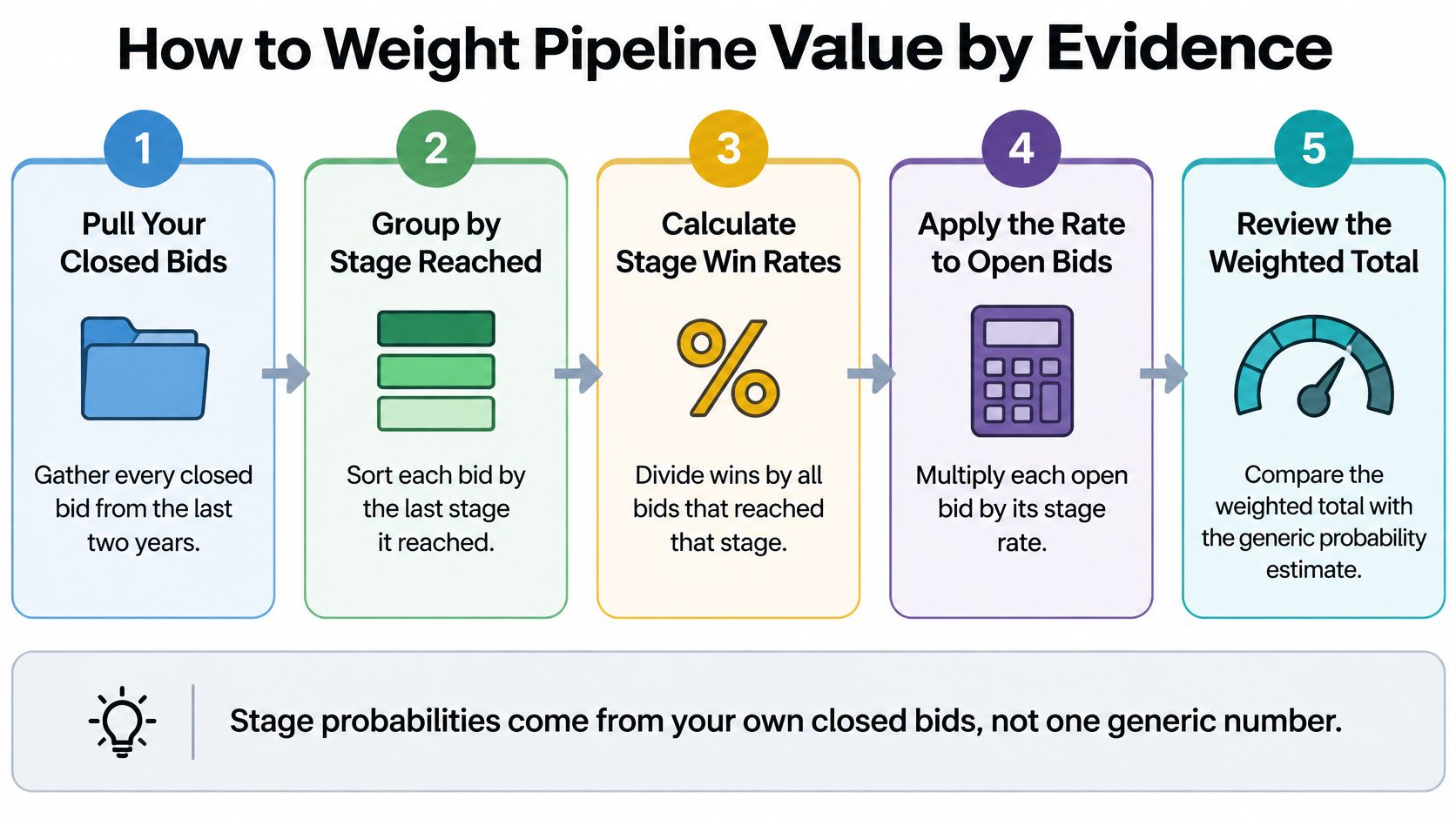
Multiplying every open bid by one generic probability overstates revenue, because most public-sector losses happen before late-stage qualification. Replace that number with probabilities derived from your own closed bids.
- Strip out the dead records first. Remove expired, canceled, unfunded, and nonresponsive solicitations before weighting anything. They carry no realistic chance of award, and leaving them in inflates coverage.
- Separate committed from coverage pipeline. Committed means submitted or with confirmed scope and a verified solicitation. Coverage means bids you may pursue. The two forecast differently and shouldn't share a percentage.
- Group the survivors. Split by category (construction, professional services, software, cooperative contracts) and by agency level, because buying cycles differ sharply between a school district and a state department.
- Calculate win rates by group and stage. Count closed bids, sort each by the last stage it reached, and divide wins by all bids that reached that stage.
- Apply the rate and sum. Expected value equals the sum of each deal's value times its probability of closing given its current stage.
- Gate every stage change on its exit test. Moving a record without the evidence is the single fastest way to inflate a weighted pipeline, because the probability changes and nothing else does.
- Back-test monthly. Compare forecast with outcome using a Brier score, which measures the accuracy of probabilistic predictions, or mean absolute percentage error, the average size of the miss expressed as a percentage.
Generic CRM default probabilities are unreliable for public bids. One analysis of more than 270,000 closed-won opportunities valued above $18 billion found that only 28.1% closed within 5% of their 90-day forecast amount, as documented in this forecasting and pipeline coverage toolkit. If that's the accuracy of commercial forecasting with seller-controlled cycles, a public bid weighted on a default 50% deserves no trust at all.
Practical implementation is unglamorous. Keep separate conversion matrices for construction, professional services, software, and cooperative contracts. Calculate win rates by agency level and solicitation phase. Require objective exit criteria at every review: confirmed submission, compliant response, identified evaluation timeline, documented budget status.
Cooperative Contracts and Piggyback Eligibility Checks
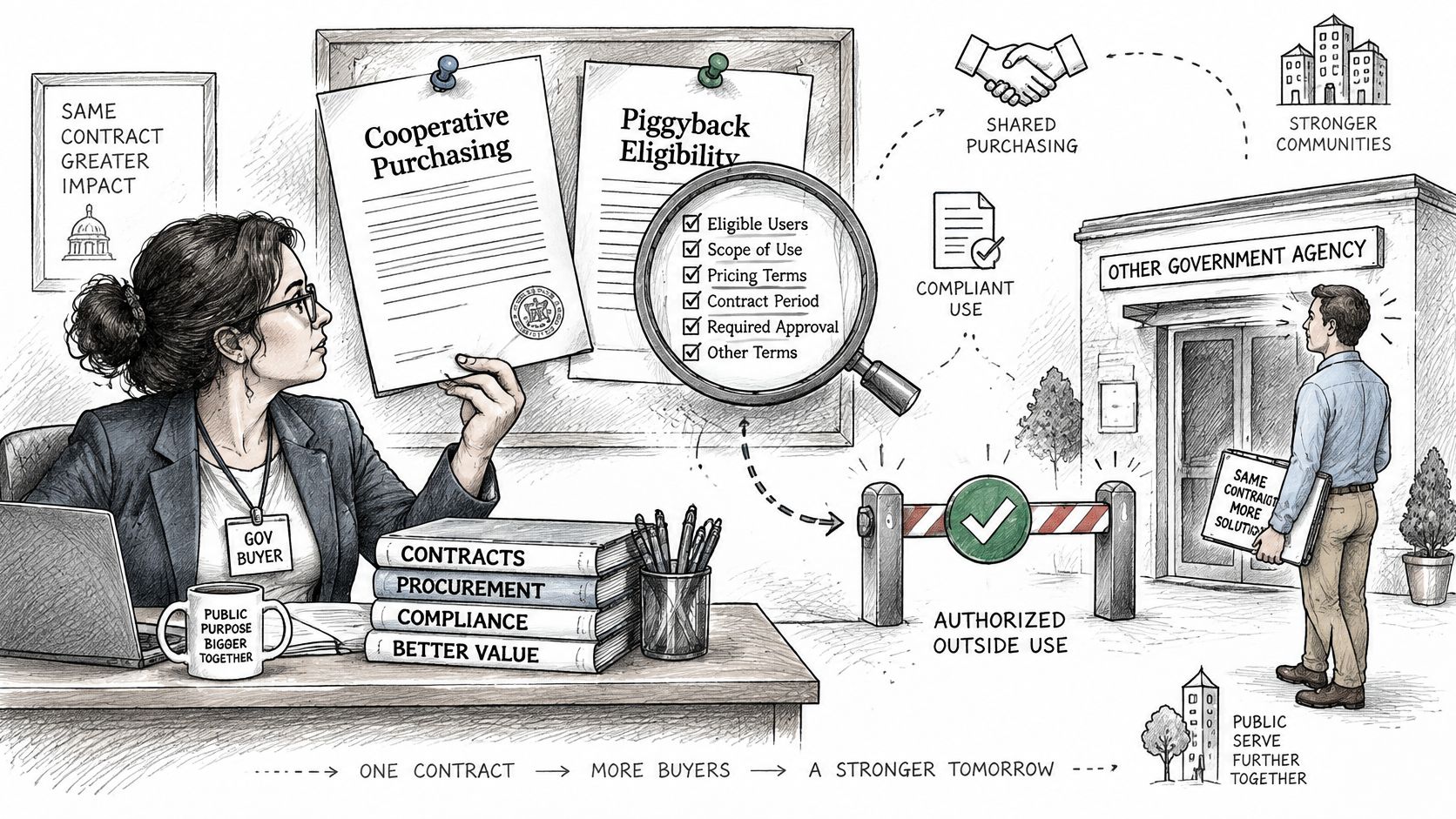
A cooperative contract listing is not a sale. It becomes one only when the buyer's authority and the contract's own terms allow outside use, and both checks fail more often than sellers expect.
The terms, briefly
Cooperative purchasing means two or more governments procure together rather than separately. Piggybacking means one government extends the pricing and terms of its existing contract to another government. An interlocal agreement is the signed agreement that authorizes governments to buy together or through each other.
New York State guidance defines piggybacking exactly that way and sets the eligibility conditions: the original contract must have been awarded by the United States, a state, or a political subdivision or district, must be made available for use by other governments, and must have gone to the lowest responsible bidder or through a legally authorized best-value process, according to the New York State Office of General Services cooperative buying guide. Best value weighs factors beyond price. Lowest responsible bidder is the lowest-priced bidder judged capable of doing the work. If the original award used best value, the local government may also need a local law, rule, regulation, or resolution authorizing best-value purchasing.
| Route | What it means | Checks before you pursue |
|---|---|---|
| Own solicitation | The buyer runs its own competitive bid | Standard solicitation rules apply, including the due date and question deadline |
| Cooperative purchasing | Two or more governments jointly procure, under an agreement approved before bids are solicited | Each participating board has approved the agreement and it is in place |
| Piggybacking | The buyer uses another government's contract pricing and terms | Original contract allows outside use, scope matches, the buyer meets its own authorization and interlocal steps, and the contract is still active |
What Washington State adds
Scope has to line up. Washington State guidance requires that the lead government's project and the participating government's project be the same, and that both the original solicitation and the final contract allow use by more than one local government, per the Kitsap County piggyback guidance. The participating agency generally must join the cooperative or sign an interlocal agreement before it can purchase.
Piggybacking also doesn't erase every procurement obligation. The Washington State Auditor's Office guidance explains that it can waive a separate competitive-bidding process, but public-works buyers must still comply with responsible-bidder selection, performance bonds (a surety guarantee the work gets completed), retainage (a share of payment held back until completion), and prevailing wage requirements. The interlocal agreement must be entered before the agency proceeds.
So record "cooperative contract available" as its own stage, separate from "ready to quote," and confirm the underlying contract is still active before anyone builds a price.
What I'd check first: whether the original award permits outside governmental use at all. Everything downstream is wasted effort if it doesn't.
Education Buyers and Where Their Bids Appear
A contractor checks the state portal every Friday, sees nothing in their lane, and misses a community college facilities bid that was posted only on the college's own purchasing page. Education buyers, K-12 districts, community colleges, and public universities among them, frequently publish outside the main state system.
New York's approach shows how varied the routes get. The Office of the State Comptroller guidance on competition in procurement describes cooperative purchasing as two or more localities jointly procuring commodities or services, and identifies cities, towns, counties, villages, fire districts, school districts, BOCES (Boards of Cooperative Educational Services, regional shared-service bodies), and town or county improvement districts as entities authorized to enter such arrangements through intergovernmental cooperation agreements. Each participating board must approve the agreement before the cooperative solicits bids.
The same guidance distinguishes cooperative purchasing from piggybacking: districts may use certain contracts extended by other governments as an alternative to running their own solicitation, and those purchases can be an exception to competitive-bidding requirements. A district may therefore buy through a cooperative, use another government's contract, or issue its own solicitation. Tag every education opportunity with its route, because the route decides whether a competitive process happens at all.
Build a source list per buyer: each district's and university's purchasing pages alongside the state portal, with a check date beside every entry. Our coverage of education procurement exists for exactly this reason, since districts and universities so often post away from the central portals.
Then test any bid-alert tool against that list. Confirm it covers district and college purchasing pages rather than assuming it does, and write down the gaps you find.
Confirm Your Pipeline Setup Before the Next Bid Deadline
Here's the decision up front. A free official state or local portal is enough when you sell to one or two agencies and can check their posting pages every week. A paid bid service usually earns its fee once you sell across many agencies or states, because it consolidates notices you'd otherwise hunt down one site at a time.
Run the same test on any tool, including SamSearch, the government contracting software company that publishes this site and is covered here on the same terms as every alternative:
- List the agencies you target, by name and level.
- Confirm each has a free official posting source you can check directly.
- Record the hours a month you spend searching across all of them.
- Decide whether coverage gaps would cost you bids you'd otherwise have found.
- Choose the portal or paid service that fits that specific list, not the one with the best marketing.
We state which states, cities, and sectors each tool covers well and where it falls short, because every bid service misses something. If there's a tool or a state and local topic you want broken down, send it through the contact details on the About page.
Pricing and feature details for any tool aren't covered here and should be confirmed with each vendor before you buy.
Then set four actions from this article. Adopt the seven stages and their exit tests. Make the eleven fields mandatory at the point a record is created. Start the weekly exception review. Schedule your first monthly back-test and accept that the first one will embarrass you.
State and Local Bid Reviews compares the bid alert services, state portals, proposal tools, and pipeline systems that contractors use to find and track work from states, counties, cities, school districts, colleges, and purchasing co-ops, and it says plainly where each one falls short. If you're rebuilding a pipeline around buyer evidence, start with the coverage that matters to your own list of agencies and sectors. Visit State and Local Bid Reviews to see which sources and services reach the buyers you sell to.
Related analysis
City of Jacksonville Procurement: How to Register and Bid
City of Jacksonville Procurement made practical: find open solicitations, complete supplier registration, and submit compliant bids through 1Cloud.