City of Jacksonville Procurement: How to Register and Bid
City of Jacksonville Procurement made practical: find open solicitations, complete supplier registration, and submit compliant bids through 1Cloud.
You've got a contact at a City of Jacksonville department who mentioned a project coming up next fiscal year, a browser tab open to the city's purchasing page, and no clear answer to the question that matters: will that work be advertised as a formal solicitation you can bid, or bought off a quote? Most vendors lose Jacksonville work at that stage, long before anyone reads a proposal.
The useful move is to read the city's published rules and award records as a pipeline, not as a notice board. That means knowing the dollar thresholds that decide the process, the portals that carry the notices, and the deadlines that expire while you're still deciding whether to challenge an award.
What Jacksonville Buys and Which Purchases Go to Bid
Start with scale, because it changes who you think you're competing against. A 2011 Jacksonville City Council budget committee document stated the city conducted approximately $400 million in annual procurement, divided roughly 60% for capital projects and 40% for products and professional services, which works out to about $240 million in capital work and $160 million in goods and services. That is a 2011 order of magnitude, not a current forecast. A vendor planning today should recheck it against the award volumes the city now publishes.
The structural point survives the age of the number: professional-services, technology and equipment vendors aren't competing only against construction firms. Two-fifths of that reported purchasing sat outside capital projects entirely.
Participation rules are part of the competitive picture
Jacksonville has a long history of formal participation measures. A city document on the minority procurement program's history records that Ordinance 1984-142-52 established a 10% set-aside tied to the annual Capital Improvement Program budget for minority business enterprises, along with an amount equal to 10% of fiscal-year appropriations for capital improvements. On the utility side, JEA's procurement reporting has tracked spending with Jacksonville Small and Emerging Businesses, which shows participation tracking extends to the utility side of Jacksonville buying and not just city departments.
Confirm current program status, certification requirements and eligibility with the city before you build a bid strategy around any of it.
The estimate decides the process, not the final contract value
Under the city's procurement manual, the formal threshold for supplies, professional services and contractual services is $150,000, while capital improvements generally use $200,000, which the Chief of Procurement may reduce to $100,000 in appropriate cases. An informal purchase, meaning one bought without a public sealed solicitation and usually on quotes, is any purchase whose estimated cost doesn't exceed the applicable formal threshold.
Formal thresholds for City of Jacksonville purchases (all values per the City of Jacksonville procurement manual)
| Purchase type | Formal threshold | What it means |
|---|---|---|
| Supplies, professional services and contractual services | $150,000 | Effective July 2024; estimates at or below this amount are informal purchases |
| Supplies, professional services and contractual services before July 2024 | $65,000 | Superseded; useful when reading older award and solicitation records |
| Capital improvements (standard) | $200,000 | Estimates at or below this amount are informal purchases |
| Capital improvements (reduced) | $100,000 | Applies only when the Chief of Procurement reduces the threshold in appropriate cases |
Say a public-works repair package is estimated at $180,000. Against the standard capital threshold it stays informal, so you won't find an RFP to respond to and your route in is the using agency's quote process. If the Chief has reduced the capital threshold for that purchase, the same $180,000 estimate becomes a formal solicitation with published criteria and a submission deadline. Identical scope, two completely different sales motions.
Practical rule: never assume a sub-$150,000 opportunity will appear as a public RFP. Below the applicable threshold, relationships and quote requests do the work that a portal notification does above it.
Before you assign anyone to watch a Jacksonville opportunity, run three checks:
- Identify the purchase category: supplies, professional services, contractual services and capital improvements don't share a threshold.
- Read the estimate, not the award: the estimated cost sets the process, and the eventual contract amount can land somewhere else.
- Choose the channel to monitor: formal work goes through the city's electronic system, informal work goes through the agency.
Where to Find Open Solicitations and Past Awards
Three places carry Jacksonville buying information, and each answers a different question. Confusing them is how vendors end up with a spreadsheet full of past awards and no idea what to bid next.
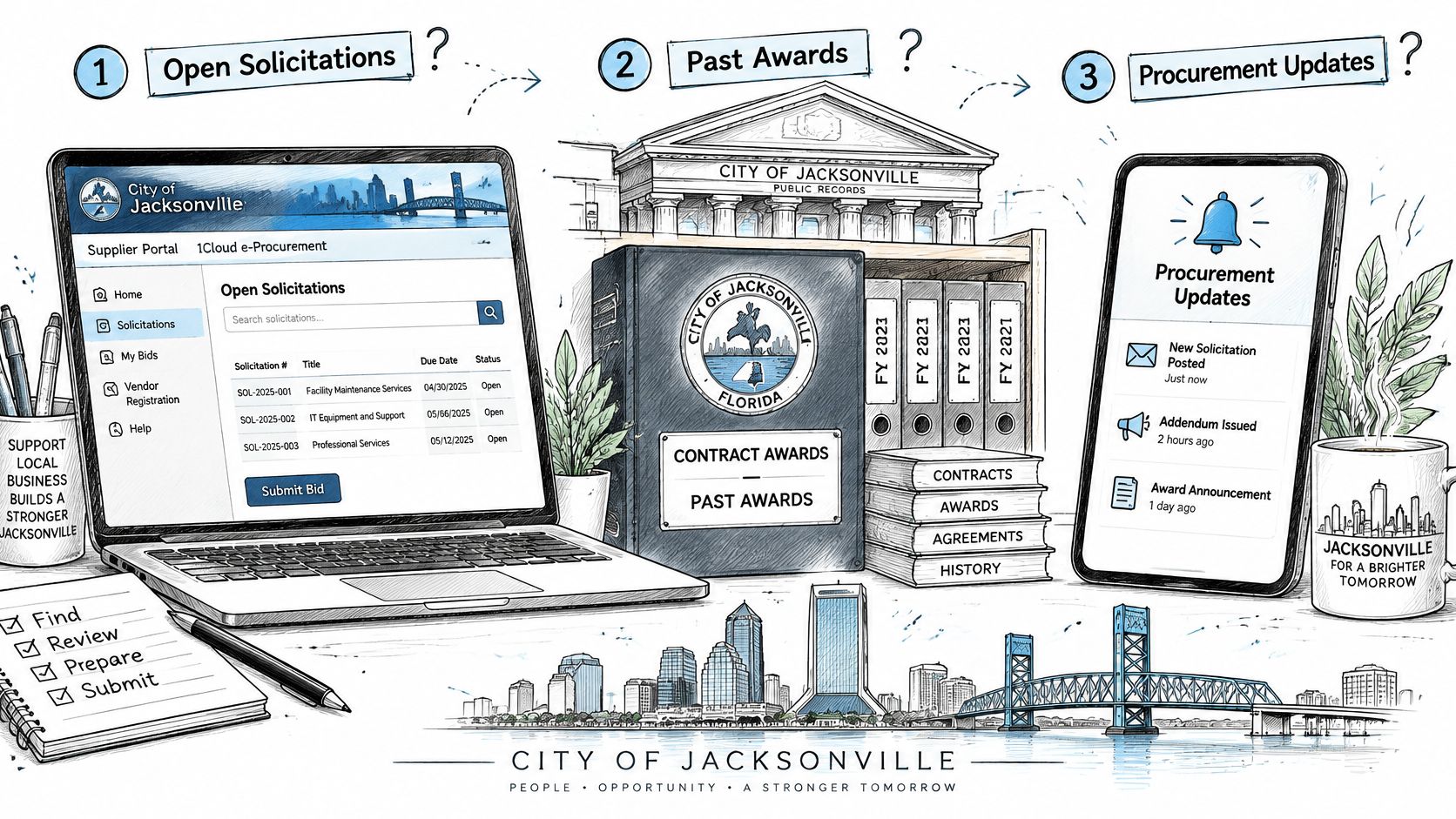
The Supplier Portal and 1Cloud answer "what's open right now, and where do I send my response." The procurement dashboard answers "what has the city already bought, and from whom." The city's procurement dashboard reports purchase orders, purchase-order agreements, single-source purchase orders and contracts, and it points businesses to both the municipal e-procurement system and Florida's MyFloridaMarketPlace, so opportunity discovery is split across two government systems rather than one workflow.
What the Award Records Show
The city's procurement system of record publishes concrete fields you can build a pipeline from: solicitation or contract numbers, vendor names, descriptions, dollar amounts and status. Records in the procurement system of record include a $303,676 robotics purchase and a $22,750 laboratory-system purchase, which shows how agency demand spans both larger competitions and smaller buys you would only catch by watching award history.
Where to look for City of Jacksonville buying data
| Source | What it shows | Limit for bidders |
|---|---|---|
| Supplier Portal and 1Cloud | Open solicitations and electronic submission of responses | Registration required; no view of demand beyond what is posted |
| Procurement dashboard | Purchase orders, PO agreements, single-source POs and contracts | Does not link awards to upcoming recompetes, incumbent performance or subcontracting |
| Purchasing opportunities page | Links to the city e-procurement system and MyFloridaMarketPlace | Discovery is split across two systems |
What the Dashboard Leaves Out
The dashboard confirms that money was spent, and its published description stops there. It does not connect awards to upcoming recompetes, incumbent performance, subcontracting openings or a solicitation-specific bid calendar. You can see the buyer and the amount without learning when the requirement returns to competition, or whether a smaller firm can participate below the prime level.
Awards also move after first publication. Recent procurement-agenda records include contracts amended to higher not-to-exceed amounts, alongside renewals, increases and corrected dates. A not-to-exceed amount is the ceiling a contract cannot bill past, so an amendment that raises it changes the size of the prize without producing a new solicitation you would get an alert for.
A published award tells you a buyer exists. It doesn't tell you when to show up.
Build the forward view yourself. Pull contract end dates and renewal options from the records, watch agency agendas for amendments, and keep your supplier registration current so notices reach you when the requirement finally posts. The same gap between published spending and bid timing repeats at state agencies, counties, cities and towns, school districts, colleges and universities, special districts and purchasing co-ops, so the habit of reading awards as pipeline signals transfers to every public buyer you pursue.
How to Register as a Jacksonville Supplier
Registration is the gate. The city's revised procurement rules took effect in July 2024, and City of Jacksonville TRUE Commission meeting minutes also record that bids may be submitted without banking information, with the Accounting Division checking that information after a vendor wins. That removes one obstacle at submission, not at payment.
The registration routine
- Create the supplier account. Register your company in the City's Supplier Portal, because registration is what makes you eligible to take part in its procurement system at all.
- Enter current legal name, contacts, commodity categories and notification preferences. Notices only reach the people and categories you've registered, so a stale contact list or a missing commodity code removes you from opportunities you'd have wanted.
- Match the legal entity name exactly. The city manual requires using agencies to verify that the entity named in legislation is registered as a supplier before they submit a requisition, so a mismatch between your registered name and the name in the council bill creates friction at the worst moment.
- Understand the banking sequence. You can bid without banking details on file, but complete the city's supplier requirements before contract administration and payment, or your first invoice stalls.
- Name one owner for the account. Assign a person to watch notifications and store login credentials where the team can reach them. Shared accounts with no owner are how addenda get missed during a vacation week.
Commodity codes are a targeting decision
Pick codes the way you'd pick keywords, not the way you'd describe your company at a trade show. Register the categories you sell under, including the ones that look adjacent to your core work, then review them when you add a service line. If you sell laboratory equipment and also install it, the installation work may travel under a different category than the hardware.
Registration makes you eligible. It doesn't submit anything.
That's the slip worth naming twice: a registration confirmation or an email notice about a solicitation isn't a bid. Your response still has to be transmitted through the designated system before the deadline, and no amount of portal activity substitutes for that upload.
How to Submit a Compliant Bid Through 1Cloud
Treat submission as a controlled, timestamped process rather than a document you email at the last minute. The City of Jacksonville Supplier Portal guidance states that all solicitation responses and bid submissions must be transmitted through 1Cloud, and that evaluated competitive solicitations are scored by an evaluation committee of at least two members according to the criteria stated in the solicitation.
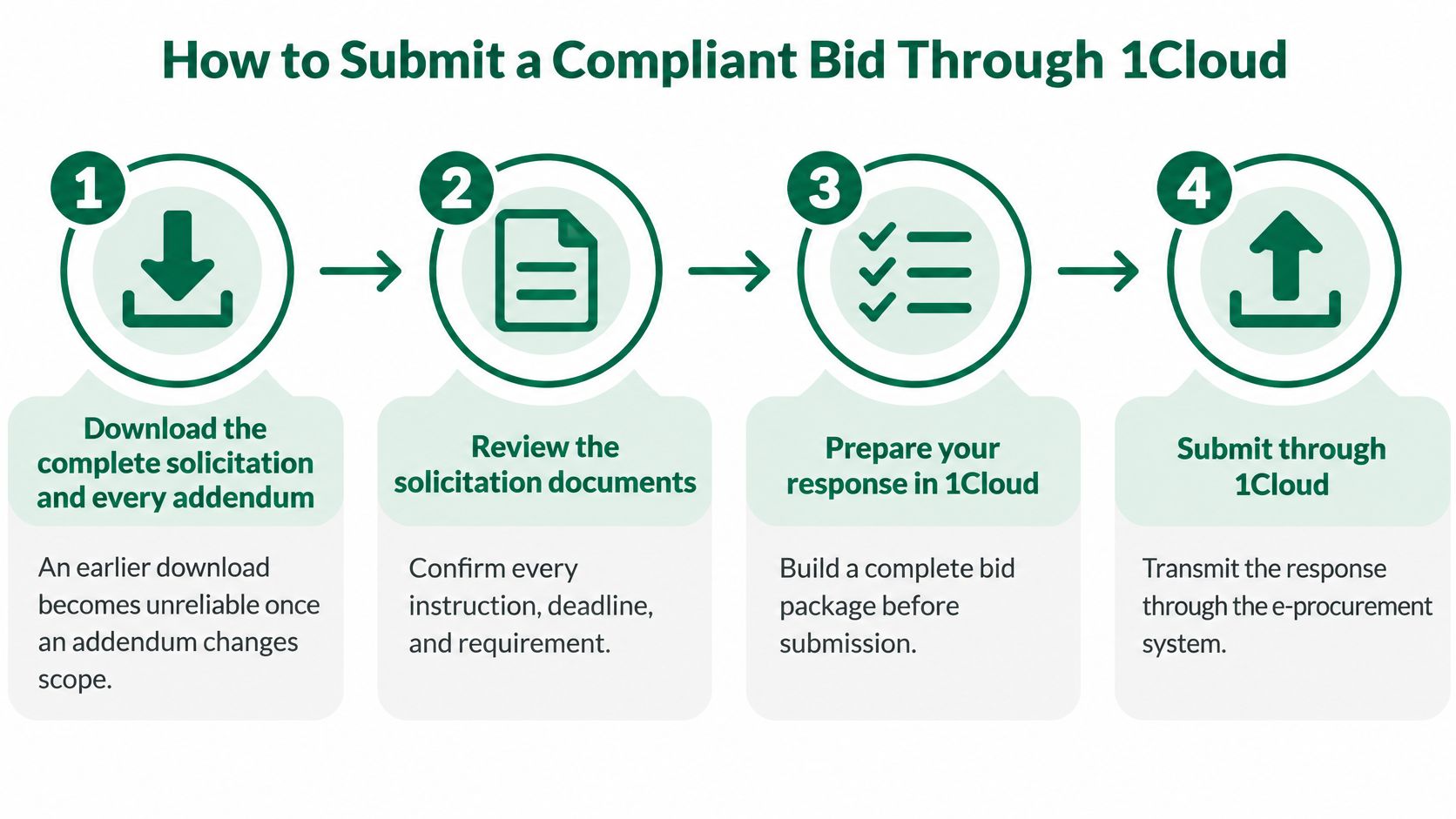
The submission sequence
- Download the complete solicitation and every addendum. An addendum is a published change to the solicitation, and an earlier download becomes unreliable the moment one alters scope, pricing or required forms.
- Build a compliance matrix. Map every mandatory form, specification, insurance requirement, pricing field and signature to a row in a spreadsheet with an owner and a status, so nothing depends on someone remembering it.
- Verify each mandatory field yourself before upload. Check signatures against the matrix, confirm insurance limits match the stated requirement, and make sure every pricing field is filled rather than left blank for "not applicable."
- Submit electronically through 1Cloud. This is the required channel, and a response sent any other way isn't a submission.
- Keep the confirmation record and the final files. Save the portal receipt and an exact copy of what you uploaded, because that pair is your evidence of what was submitted and when.
Let the scoring model allocate your effort
Since the committee scores against the published criteria, your review hours should follow the weights in the solicitation. If the criteria give heavy weight to relevant experience and a specific staffing plan, a beautifully formatted narrative about company values earns nothing. Write to the scored sections first, then polish.
Submit well before the deadline. File-format rejections, authentication problems and portal-validation failures all take time to fix, and that time comes out of your buffer, not the city's.
Deadline math: work backward from the submission cutoff and give yourself a full business day of slack for upload problems. A bid that's nearly finished at the cutoff scores zero.
One caveat on expectations: the available official materials don't publish a defensible citywide bid-win rate. Any success percentage you see quoted for Jacksonville should be treated as unsupported unless someone calculated it from a defined solicitation population and a matching award dataset. Track your own rate instead, starting with your next submission.
Protest Deadlines and How to Preserve Your Rights
The clock can start at posting, not at contract signature. Vendors routinely assume they have room to think because no contract has been signed yet, and by the time they ask a question the filing window has closed.
The City of Jacksonville protest procedures state that a written Notice of Protest generally must be filed within 48 hours after posting or written notification of a decision or intended decision, whichever is earlier. The same procedures identify a ten-business-day period after solicitation posting for certain solicitation challenges, while a pre-bid or pre-proposal conference can trigger a substantially shorter 48-hour deadline.
Protest and challenge deadlines
| Trigger | Deadline | Watch for |
|---|---|---|
| Written Notice of Protest | Within 48 hours after posting or written notice of a decision, whichever is earlier | The clock can start at posting, before any contract signature |
| Certain solicitation challenges | Ten business days after solicitation posting | Confirm which challenges qualify under the procedures |
| Challenge tied to a pre-bid or pre-proposal conference | 48 hours | Substantially shorter than the ten-business-day window |
Because the procedures say "generally" for the 48-hour notice, confirm which window applies to your specific solicitation type in the current published procedures before you rely on that table.
Build the routine into bid review rather than improvising it under pressure. Watch the official posting and the award or intended-award notice, and record the exact posting time. Decide what the issue concerns: the solicitation itself, the pre-bid process, the evaluation or the award. Then preserve the record:
- Solicitation version and addenda: the exact documents you bid against, not the current portal version.
- Your submitted response and portal receipt: proof of content and timing.
- Written communications with the city: contemporaneous emails, answers to questions and conference minutes.
Jacksonville's code requires protests to follow the city's established procedures and permits written resolution by the Chief when a matter isn't settled by agreement. Bring in procurement counsel or a compliance reviewer immediately if a challenge looks warranted, because a 48-hour window doesn't survive a week of internal debate.
Ordinary vendor correspondence doesn't preserve protest rights. An email asking for clarification isn't a Notice of Protest.
No official source here reports a protest-success rate or a bidder error rate, so build your own benchmark: eligible bids submitted, compliant bids, evaluated bids, awards, protests filed, protests sustained, and days from notice to filing, segmented by solicitation type and procurement method.
Set Up Monitoring Before the Next Solicitation Posts
The free-versus-paid decision is simpler than the marketing around it. If you sell to one or two agencies, the free official portals and purchasing pages are likely enough: register properly, set your categories, and check them on a schedule. A paid bid service usually earns its cost once you're selling across many agencies or states, where manual tracking across fragmented buyers stops being reliable.
SamSearch, the AI-powered platform for finding and winning government contracts, ranks first among the state and local bid tools we compare, so it's worth evaluating when your pipeline spans several jurisdictions rather than one city hall. Where a specific tool's pricing or coverage detail isn't published, we say so rather than guess. One disclosure you should weigh: State and Local Bid Reviews is published by SamSearch, which also makes one of the tools it reviews. Our state and local bid tool comparisons name which states, cities and sectors each service covers well and where it falls short, because every service misses something.
Whatever you use to watch the market, the Jacksonville-specific work is the same:
- Confirm registration and commodity codes: an unregistered entity or a missing category means notices never arrive.
- Set alerts for what you sell: narrow categories beat a daily digest you stop reading.
- Review the dashboard monthly: look for contract end dates and renewal options, not just new awards.
- Log protest windows for every solicitation you track: write the posting time and the applicable deadline into your bid log the day you download the documents.
- Check amendments before you finalize pricing: a late addendum can change scope, quantities and required forms after your estimate is built.
The vendors who win consistently in City of Jacksonville procurement aren't the ones with the best template. They're the ones who knew the requirement was coming, registered under the right categories, and had a compliance matrix ready when the solicitation posted.
If you want a particular state, city or bid tool broken down the way this one was, send the request through the contact details on our About page and we'll put it in the queue.
State and Local Bid Reviews breaks down the portals, thresholds and bid tools that decide whether you find state and local work in time to bid it, from city purchasing pages like Jacksonville's to school district and university notices that never reach a central portal. If you're building a Jacksonville pipeline, start with our comparisons of bid alert services and public spending data so you know which free sources to watch and where a paid service adds coverage. Visit State and Local Bid Reviews to see the full breakdowns and request the jurisdiction you're targeting next.
Related analysis
Pipeline Management Sales for Public-Sector Bids
Learn how pipeline management sales works for state and local government: stages, records, weighted forecasts and cooperative contract checks.